 Honeycomb
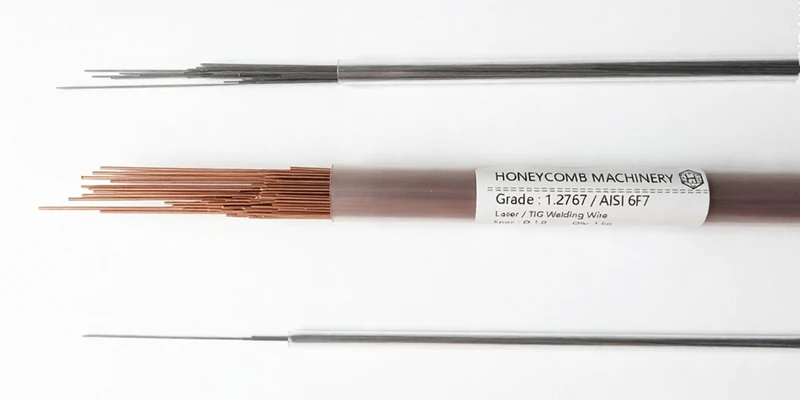
Select Welding Process & Diameters
Choose between Laser Welding or TIG Welding wire specifications.
0.15
mm
Spool / Rods0.2
mm
Spool / Rods0.3
mm
Spool / Rods0.4
mm
Spool / Rods0.5
mm
Spool / Rods0.6
mm
Spool / RodsCustom
Other Sizes
Contact Us →
0.8
mm
10 rods / tube1.0
mm
10 rods / tube1.2
mm
10 rods / tube1.6
mm
10 rods / tube2.0
mm
10 rods / tube2.4
mm
10 rods / tubeCustom
Other Sizes
Contact Us →
TECHNICAL DATA SHEET (TDS) & PROCESS GUIDE Standard: DIN 1.2767 / EN 45NiCrMo16
1. Chemical Composition (wt%)
| Element | C | Si | Mn | Cr | Mo | Ni | Fe |
|---|---|---|---|---|---|---|---|
| Specification | 0.40–0.50 | 0.10–0.40 | 0.20–0.50 | 1.20–1.50 | 0.15–0.35 | 3.80–4.30 | Balance |
2. Welding Parameters: Laser vs. TIG
⚡ Laser Welding 0.15–0.6 mm
| Preheat Temp | Room Temp – 120°C |
| Pulse Power | 120–220 A |
| Shielding Gas | Argon ≥99.99% (3–6 L/min) |
| HAZ Impact | Low HAZ, prevents edge spalling and micro-cracks |
🔥 TIG Welding 0.8–2.4 mm
| Preheat Temp | 300°C – 400°C Mandatory |
| Welding Current | 40–120 A (DCEN) |
| Shielding Gas | Argon ≥99.99% (8–12 L/min) |
| Post-Heat | Slow cooling in thermal blanket |
💡 Key Repair & Operation Instructions:
- Extreme Impact Toughness: The high nickel concentration (~4% Ni) ensures unmatched impact resistance and toughness, making it ideal for repairing mold parting lines that suffer heavy mechanical clamping stress.
- Crack Prevention (TIG): Preheating to 300°C+ during TIG welding is required to handle deep repair layers and avoid stress concentration cracks.