 Honeycomb
Select Welding Process & Diameters
Choose between Laser Welding or TIG Welding wire specifications.
0.15
mm
Spool / Rods0.2
mm
Spool / Rods0.3
mm
Spool / Rods0.4
mm
Spool / Rods0.5
mm
Spool / Rods0.6
mm
Spool / RodsCustom
Other Sizes
Contact Us →
0.8
mm
10 rods / tube1.0
mm
10 rods / tube1.2
mm
10 rods / tube1.6
mm
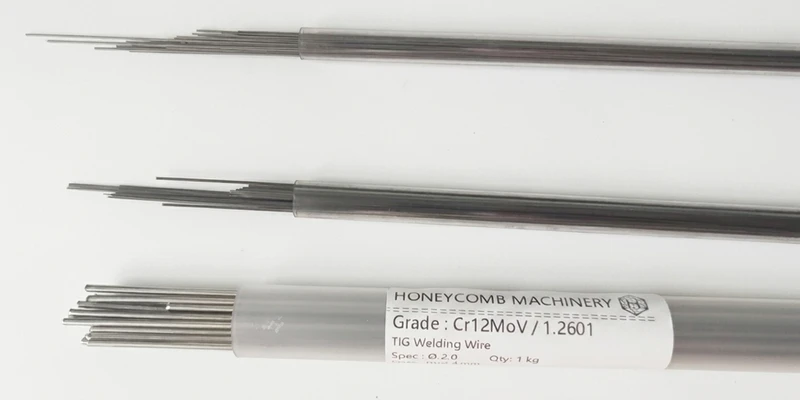
10 rods / tube2.0
mm
10 rods / tube2.4
mm
10 rods / tubeCustom
Other Sizes
Contact Us →
TECHNICAL DATA SHEET (TDS) & PROCESS GUIDE Standard: Cr12MoV / DIN 1.2601 (X165CrMoV12 High-Chromium Cold Work Steel)
1. Chemical Composition (wt%)
| Element | C | Si | Mn | Cr | Mo | V | Fe |
|---|---|---|---|---|---|---|---|
| Specification | 1.45–1.70 | ≤ 0.40 | ≤ 0.40 | 11.50–12.50 | 0.40–0.60 | 0.15–0.30 | Balance |
2. Hardness & Welding Parameters
⚡ Laser Welding 0.15–0.6 mm
| Preheat Temp | Room Temp – 150°C |
| Pulse Power | 110–200 A |
| Shielding Gas | Argon ≥99.99% (3–5 L/min) |
| HAZ Impact | Precision pulse welding prevents micro-cracking along sharp edges |
🔥 TIG Welding 0.8–2.4 mm
| Preheat Temp | 300°C – 400°C Essential |
| Welding Current | 40–110 A (DCEN) |
| Shielding Gas | Argon ≥99.99% (8–12 L/min) |
| Post-Heat Relief | Slow cooling in insulation blanket to relieve internal stress |
💡 Key Repair & Operation Instructions:
- Pre-Heat Crack Prevention: Due to ~12% Chromium content, TIG repair on thick tool bodies requires mandatory preheating (300°C–400°C) to avoid thermal stress cracking.
- Wear Resistant Edge Deposit: Reaches 56–60 HRC after deposition, offering great resistance against abrasive wear on cold shearing and punching edges.